
SDG 8: Decent Work and Economic Growth

SDG 8: Decent Work and Economic Growth
General overview
This chapter’s primary objective is to accumulate, systematize, structure and present extensive information about the UN Sustainable Development Goal 8 in a condensed way to be easily understandable for students. More attention was paid to reviewing the targets and indicators of Goal 8, their requirements, significance, and analysis of their implementation status for 2016-2024. A succinct review that highlights the key findings and suggestions is given at the end of the chapter.
Supporting educational resources, UN Secretary-General reports, Department of Economic and Social Affairs analytical materials, and international organization statistics were primarily employed throughout the chapter’s development. The texts provided in the cited sources are presented with just little modifications to prevent any ambiguity, which removes the possibility of information interpretation and boosts its credibility.
Reading this chapter will teach you:
- What key targets and indicators does Goal #8 include;
- What progress has been made in achieving Goal 8 and what is the current status;
- What does inclusive and sustainable economic growth mean;
- What is the state of forced labor, modern slavery, and labor rights around the world;
- What are the main challenges we face in achieving the key results of Goal 8.
Key terms and definitions:
- Economic growth – It is used to convey improvements in a nation’s economic status and describes the quantitative expansion of the economy, the rise in the amount of the nation’s wealth (real gross domestic product, or GDP), and the potential for output.
- Fundamental labor rights – The legal and human rights pertaining to labor relations between employees and employers are known as workers’ rights. These rights generally have an impact on working conditions in employment relationships.
- Inclusive economic growth – is economic growth that generates opportunity for everyone and is dispersed equitably throughout society. (OECD, 2008) The World Bank claims that inclusive growth is one of the economic growth models that considers: 1) the participation of all societal sectors in the process of guaranteeing growth 2) the greatest potential dispersion of growth outcomes.
- Informal labor – is distinct from formal labor in that its processes take place outside of state rules. As a result, someone working informally is unable to receive even the bare minimum of benefits that the law requires of employees.
- Labor productivity – a gauge of how well and efficiently human labor works. Output per worker and labor intensity per unit of output are two metrics that show how much output is produced by one worker in a given amount of time or how long it takes to achieve a unit of output.
- Least Developed Countries (LDCs) – are low-income countries which are highly vulnerable to economic and environmental shocks and have low levels of human assets.
- Unemployment – refers to the situation where people of working age are actively looking for work but are unable to find it. The unemployment rate represents the number of unemployed people as a percentage of the labor force and is calculated as follows:
B = K / Chrs * 100%, where K – number of unemployed; Chrs – total labor force. Labor force data are limited to people aged 16 and older.
Introduction
Although there are other definitions of sustainable development (SD), the Brundtland Report, also known as Our Common Future, is the one that is most commonly cited: “Sustainable development is development that meets the needs of the present without compromising the ability of future generations to meet their own needs.” (IISD 2024)
Sustainable development is a multi-dimensional way of thinking about the interdependencies among natural, social, and economic systems in our world. Scheme 1 is an example of how economics, finance, trade, energy, agriculture, industry, and all other policies are applied to create development that is sustainable on all levels—economically, socially, and environmentally (World Commission on Environment and Development 2000: 68-70).
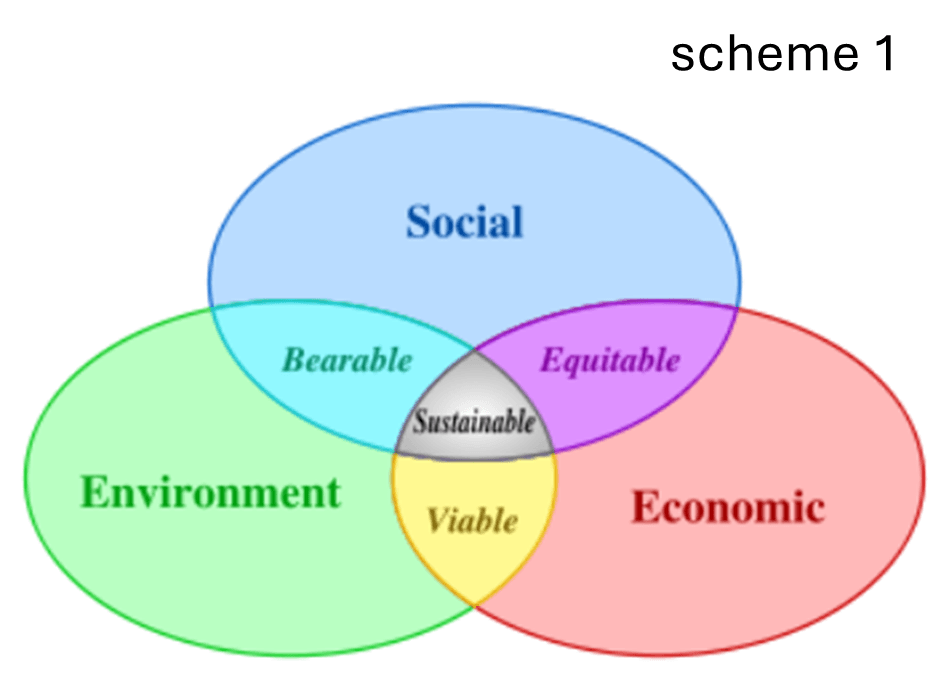
Goal 8 is “Decent work and economic growth”, which is one of the 17 Sustainable Development Goals (SDGs) established by the UN in 2015.
Decent Work and Economic Growth – means creating an enabling environment where people can secure productive and decent employment that promotes their well-being.
SDG 8 aims to promote:
- Inclusive and sustainable economic growth,
- Employment and decent work for all.
It focuses on the:
- achievement of higher levels of productivity and technological innovation,
- reduction of youth unemployment,
- elimination of forced labor, modern slavery, and human trafficking, and
- protection of labor rights to ensure a safe and secure working environment.
SDG8 focuses on creating opportunities for everyone to have access to quality employment that provides fair wages, social protection, and safe working conditions. It seeks to eradicate forced labor, child labor, and all forms of discrimination in the workplace. The main initiatives of this goal are:
- Job Creation and Entrepreneurship,
- Labor Rights and Social Protection and
- Gender Equality in the Workplace.
These initiatives include the following:
Job Creation and Entrepreneurship
Promoting policies and programs that foster job creation, particularly in sectors that contribute to sustainable development (renewable energy, green technology, digital innovation). Encouraging entrepreneurship and supporting small and medium-sized enterprises (SMEs) also play a crucial role.
Labor Rights and Social Protection
Ensuring compliance with international labor standards is essential to protect workers’ rights. This includes fair wages, safe working conditions, and the elimination of forced labor and child labor. Additionally, establishing social protection systems that provide access to healthcare, education, and income security helps to create a safety net for workers and their families, promoting their well-being and reducing poverty.
Gender Equality in the Workplace
Promoting gender equality in the workplace is a crucial aspect of achieving decent work and economic growth. It involves ensuring equal opportunities for employment, eliminating gender-based discrimination in hiring, promotion, and pay, and encouraging the participation of women in decision-making roles and sectors traditionally dominated by men. Gender-responsive policies are essential to unlock the full potential of all individuals.
The goal emphasizes the importance of economic growth that is sustainable, inclusive, and benefits all members of society.
SDG 8 Targets and indicators
It is divided into 10 main and 2 additional targets, which have special evaluation indicators.
| # | Target | Indicator |
|---|---|---|
| 8.1 | Sustain per capita economic growth in accordance with national circumstances and, in particular, at least 7% GDP growth per annum in the least developed countries | 8.1.1. Annual growth rate of real GDP per capita |
| 8.2 | Achieve higher levels of economic productivity through diversification, technological upgrading and innovation, including through a focus on high value added and labor-intensive sectors | 8.2.1. Annual growth rate of real GDP per employed person |
| 8.3 | Promote development-oriented policies that support productive activities, decent job creation, entrepreneurship, creativity and innovation, and encourage the formalization and growth of micro-, small- and medium-sized enterprises, including through access to financial services | 8.3.1. Proportion of informal employment in total employment, by sector and sex |
| 8.4 | Improve progressively, through 2030, global resource efficiency in consumption and production and endeavor to decouple economic growth from environmental degradation, with developed countries taking the lead | 8.4.1. Material footprint, material footprint per capita, and material footprint per GDP 8.4.2. Domestic material consumption, domestic material consumption per capita, and domestic material consumption per GDP |
| 8.5 | By 2030, achieve full and productive employment and decent work for all women and men, including for young people and persons with disabilities, and equal pay for work of equal value | 8.5.1. Average hourly earnings of female and male employees, by occupation, age and persons with disabilities 8.5.2. Unemployment rate, by sex, age and persons with disabilities |
| 8.6 | By 2020, substantially reduce the proportion of youth not in employment, education or training | 8.6.1. Proportion of youth (aged 15-24 years) not in education, employment or training |
| 8.7 | Take immediate and effective measures to eradicate forced labor, end modern slavery and human trafficking and secure the prohibition and elimination of the worst forms of child labor and by 2025 end it in all its forms | 8.7.1. Proportion and number of children aged 5 17 years engaged in child labor, by sex and age |
| 8.8 | Protect labor rights and promote safe and secure working environments for all workers, including migrant workers, in particular women migrants, and those in precarious employment | 8.8.1. Fatal and non-fatal occupational injuries per 100,000 workers, by sex and migrant status 8.8.2. Level of national compliance with labor rights based on ILO textual sources and national legislation, by sex and migrant status |
| 8.9 | By 2030, devise and implement policies to promote sustainable tourism that creates jobs and promotes local culture and products | 8.9.1. Tourism direct GDP as a proportion of total GDP and in growth rate |
| 8.10 | Strengthening the capacity of domestic financial institutions to encourage and expand access to banking, insurance and financial services for all | 8.10.1. (a) Number of commercial bank branches and (b) number of automated teller machines (ATMs) per 100,000 adults 8.10.2. Proportion of adults (15 years and older) with an account at a bank or other financial institution or with a mobile-money-service provider |
| 8.a | Increase Aid for Trade support for developing countries, least developed countries, including through the Enhanced Integrated Framework for Trade-Related Technical Assistance to Least Developed Countries | 8.a.1. Aid for Trade commitments and disbursements |
| 8.b | By 2020, develop and operationalize a global strategy for youth employment and implement the Global Jobs Pact of the ILO | 8.b.1. Existence of a developed and operationalized national strategy for youth employment, as a distinct strategy or as part of a national employment strategy |
Brief historical overview
It is known that the SDGs were approved in 2015. Since then, the world has encountered certain challenges that have made it much more difficult to accomplish the Sustainable Development Goals. The COVID-19 epidemic and Russia’s unjustified invasion of democratic Ukraine have been the most prominent of them.
The world economy has started to gradually recover, despite the fact that these crises are still not entirely over. An examination of development patterns, however, indicates that activity can stay below pre-crisis levels for a long time. And this is in a setting where attaining sustainable development depends on inclusive and sustainable economic growth. Annual monitoring of the results of the SDGs began in 2016. Let’s consider the main results, facts, and statistical information for the period of 2016-2024. In addition, in some cases, the period before a specific year will be discussed in order to make current processes more understandable.
2016-2019. The initial stage of implementation and monitoring of the SDGs (Reports of the Secretary General 2017; 2018; 2019; 2020)
Since the turn of the century, SDG8’s primary objectives have grown in significance. Since the SDGs went into effect globally, this has become even more apparent. Globally, labor productivity has risen and the unemployment rate has fallen during the reviewed period. However, in order to ensure sustained and inclusive economic growth, more progress was required to improve access to financial services, promote safe and secure working environments, decrease informal employment and labor market inequality (particularly with regard to the gender pay gap), and increase employment opportunities, particularly for youth. Beginning in 2019, the pandemic has caused a sudden and significant disruption in economic growth, causing the world to enter a recession. Several important facts and events took place, among which we consider the following to be worthy of note:
Global economic growth and real Gross Domestic Product (GDP) per capita
During above mentioned period, real GDP per capita grew by 1.3% globally, below the 1.7% average growth rate recorded in recent years. In 2017, the global growth rate of real GDP per capita was 1.9% and was expected to remain at about 2% from 2018 to 2020. This was significantly less than the 3% rate attained in 2010 and slightly higher than the 2015 rate of 1.63%.
Real GDP growth rate for LDCs was expected to increase from 4.5% in 2017 to 5.7% in 2020, which is less than the 7% envisioned by the 2030 Agenda. But, in reality, it fell sharply from 5.7% to 2.3%.
In 2018, the rate of growth of global real GDP per capita was 2%. In addition, the rate for LDCs was 4.5% in 2018, less than the 7% growth rate targeted in the 2030 Agenda.
Global real GDP per capita increased by only 1.3% in 2019 and is estimated to have declined by 5.3% in 2020 owing to the pandemic.
Small and medium enterprises, workers in informal employment, the self-employed, daily wage earners and workers in sectors at the highest risk of disruption have been hit the hardest.
Labor productivity
The global unemployment rate
In all age groups, women were more likely than males to be unemployed, with the rate falling from 6.4% in 2000 to 5.7% in 2016. Since 2009, when it reached 5.9%, the drop has halted. The global youth unemployment rate was 4.4% in 2016 and 13% in 2017, making young people nearly three times as likely as adults to be unemployed. This rate eventually recovered from the global economic crisis in 2018 and was 5.0%, which was the same as it was before the crisis.
The unemployment rate was 5% worldwide in 2019, with Northern Africa and Western Asia having the highest rates at 11%. In 2019, young workers had a significantly higher rate than adults across all regions, with the disparity reaching 18% in Western Asia and Northern Africa, 15% in Central and Southern Asia, and 12% in Latin America and the Caribbean.
- In more than 76% of countries with data, more than 1 in 10 youth are neither in the educational system nor working.
- Young women are more likely than young men to fall into that category in almost 70% of countries with data.
Informal employment
Globally, 61% of all workers were engaged in informal employment in 2016. Excluding the agricultural sector, 51% of all workers fell into this employment category.
With 89% and 86% of workers, respectively, in sub-Saharan Africa and Central and Southern Asia, the need to rely on informal employment was more common in these regions. Approximately 1.6 billion people in the informal economy, or half of the world’s workforce, are greatly impacted by the pandemic’s effects on unemployment and underemployment. In the initial months of the crisis, informal laborers’ incomes dropped by 60% worldwide.
Informal employment has an impact on the adequacy of earnings, occupational safety and health and working conditions.
Youth in NEET
One fifth of young people worldwide were not in education, employment, or training in 2018. This means that they were not obtaining professional experience or developing skills through educational or vocational programs during their prime. The gender disparity is pronounced. 22% of young people worldwide were unemployed, untrained, or not enrolled in school in 2019. This percentage has barely changed since 2005. Based on data from 102 nations in 2019, 98% of them had a youth employment strategy in place or planned to create one soon.
Young women were more than twice as likely as young men to be unemployed or outside the labor force and not in education or training.
Gender inequality
In 89% of these countries, the hourly wages of men are, on average, higher than those of women, with a median pay gap of 12.5%.
Decent work for all
During this period, many workers around the world were exposed to undue risks in their workplaces. Based on recent data from 55 countries, a median of 3 deaths occurred per 100,000 employees, and a median of 889 non-fatal injuries occurred per 100,000 employees.
Child labor
Even though there were less children aged 5 to 17 working between 2016 and 2019, child labor was still a major concern. 85 million children, or more than half of all child laborers, engaged in dangerous jobs, with 59% of them employed in agriculture. Up until 2016, when the number of females working as children fell by 40% and the number of boys doing so by 25%, girls made more progress than boys.
Access to financial services
Globally, access to finance was increasing, but as technology became more and more prevalent, the way that access was obtained appeared to be shifting. Only 35% of individuals in low-income nations have an account at a bank or other financial institution, whereas nearly all adults in high-income countries have. Women fall short of men in this area in every location.
Between 2010 and 2017, there were about 50% more ATMs per 100,000 adults worldwide (from 45 to 66), and in the least developed countries (from 2.3 to 5.8), there were 69 in 2019. With more consumers turning to digital banking options, the number of commercial bank branches per 100,000 adults increased by just 2% between 2010 and 2017. The trend for commercial bank branches did, however, slightly reverse in 2019, with a slightly smaller number of branches in 2019 than in 2010.
Aid for trade
Aid for trade obligations dropped from $55.2 billion in 2015 to $51 billion in 2016. Decline was the highest in the energy sector (falling by $2.4 billion), followed by banking and financial services (by $1.3 billion), and the agriculture sector (by $1 billion).
However, it more than doubled the baseline pledges of 2002-2005 in 2017, rising to $58 billion. The sectors with the biggest increases in absolute terms were banking and financial services ($1.0 billion), industry ($1.0 billion), and agriculture ($1.7 billion). The restoration of trade-related infrastructure obligations and additional increases in banking and agricultural support were the main drivers of the growth.
Based on current pricing, aid for trade obligations stayed constant in 2018 at $58 billion. The largest percentage was collected by South and Central Asia (31.4%), followed by sub-Saharan Africa (29.2%). The least developed nations received 36.8% of trade aid, while lower-middle-income countries received 37.5%. Additionally, this trend persisted in 2019.
In 2019, aid for trade commitments decreased by 6% to $53 billion and the sectors most represented were energy (27.9% of total), transport and storage (22.6%) and agriculture (17.8%).
2020-2022 the period of pandemic and economic recession (Report of the Secretary-General 2021; 2022; 2023)
The average growth of the world economy had already slowed prior to the onset of the COVID-19 epidemic. The pandemic has significantly impacted working hours and earnings, causing the biggest worldwide economic downturn since the Great Depression. 255 million full-time jobs, or 8.8% of working hours worldwide, were lost in 2020 compared to the fourth quarter of 2019. This is roughly four times more than the number of hours lost during the global financial crisis in 2009. The labor market crisis disproportionately affected women and young people in the workforce. The worst economic catastrophe in decades was unleashed in 2020 by the COVID-19 epidemic, which had a devastating effect on working hours and earnings. The global economy began to recover in 2021, but by the end of the year, waves of COVID-19 infections, growing inflation, significant supply chain disruptions, policy uncertainty, and developing nations’ unmanageable debt forced the global economy to slow down. In 2022, Russia’s unprovoked aggression against Ukraine severely hampered global economic expansion.
Global economic growth and real Gross Domestic Product (GDP) per capita
Global real GDP per capita fell by 4.4% in 2020 after rising by roughly 1.4% in 2019. Based on pre-war projections, global real GDP per capita was expected to grow by 3.0% in 2022 and 2.5% in 2023 after recovering at a growth rate of 4.4% in 2021. Less developed nations’ real GDP increased by 5.0% in 2019, but the pandemic’s disruption prevented development in 2020.
Due to the disruption created by the pandemic, the real GDP of the least developed nations increased by 4.8% in 2019 and decreased by 1.3% in 2020. In 2021 and 2022, the real GDP per capita worldwide grew by 3.6% and 2.6%, respectively.
Labor productivity
The COVID-19 pandemic resulted in unprecedented, volatile developments in labor productivity levels. Globally, output per worker grew at an average annual rate of 1.6% between 2015 and 2019. In 2020, the output per worker dropped by 0.6%, the first such decline since 2009. Global labor productivity rebounded sharply in 2021, rising by 3.2%.
The global unemployment rate
In 2020, there were 33 million more unemployed people worldwide, and the unemployment rate rose by 1.1 percentage points to 6.5%. Due to COVID-19-related constraints, an additional 81 million people were either not actively looking for work or were just unable to find it. With employment losses in 2020 of 8.7 and 5%, respectively, compared to 3.7% for all adults and 3.9% for men, young people and women were disproportionately affected by the crisis.
However, unemployment figures reflect only a small proportion of the jobs lost because of the pandemic.
In 2021, the rate declined slightly to 6.2%, which was still well above the pre-pandemic rate of 5.4%. ILO was projecting that unemployment will remain above its 2019 level until at least 2023.
Comparing the fourth quarter of 2019 to 2021, there was a 4.3% decrease in working hours worldwide, or 125 million fewer full-time jobs (assuming a 48-hour workweek).
Meanwhile, the unemployment rate underestimated the impact of the crisis on full employment, as many who left the workforce did not return, nor did it reflect the reduction in working hours for those who remained employed.
Informal employment
Two billion people worked in informal jobs, which were defined by a lack of social protection coverage and other fundamental protections, making up 60.2% of all employment worldwide prior to the pandemic. Over three quarters, or 1.6 billion informal workers, were either employed in the most severely impacted sectors or were greatly impacted by the lockdown measures connected to the pandemic.
They were at high risk of falling into poverty and faced greater difficulties in restoring their livelihoods during the recovery period.
COVID-19 pandemic containment measures and mobility restrictions prevented labor reallocation to informal employment.
At the height of the crisis, some countries saw a decline in the informal employment rate, reflecting a disproportionate impact on informal workers. This has left informal workers and their families in a highly precarious position, vulnerable to sudden income losses and increased risks of falling into poverty.
Instead of remaining unemployed or moving into informal jobs, as in previous crises, both laid-off employees and self-employed workers left the workforce.
Youth in NEET
By 2005, more than one in five young people worldwide were not in employment, education or training (NEET), and this percentage has remained virtually unchanged to this day. According to quarterly data, in 42 of the 49 nations and territories having data, the rate rose between the fourth quarter of 2019 and the second quarter of 2020. The gender disparity among young individuals in NEET is expected to widen since women have been disproportionately forced into inactivity throughout the pandemic, and young women were already twice as likely as young men to be in NEET. Of the 107 countries and territories with data in 2020, nearly one-third developed and operationalized a youth employment strategy, 44 (41.1%) had such strategies but did not offer concrete proof of their implementation, and less than one-quarter (24.3%) were still in the process of doing so.
The development and implementation of national youth employment strategies were increasing across most regions. Out of 81 countries reporting in 2021, more than half have operationalized such strategies, while slightly less than one third have developed one but did not provide conclusive evidence on implementation.
Child labor
Latest estimates indicate that the number of children in child labor rose to 160 million (63 million girls and 97 million boys) worldwide at the beginning of 2020, representing an increase of 8.4 million children in the last 4 years and translating into almost 1 in 10 of all children in child labor worldwide.
Access to financial services
Since 2015, there has been a global increase in financial access, with new channels of access becoming more significant in recent years. In 2020, there were 67.3 ATMs per 100,000 adults worldwide. In 2020, however, there were 14.4 fewer commercial bank branches per 100,000 people. While both measures decreased internationally and in the majority of locations between 2019 and 2020, the COVID-19 epidemic appeared to have further supported the usage of digital financial access methods.
Tourism
Over the ten years leading up to 2019, the worldwide GDP from tourism grew faster than the rest of the economy, making up 4.1% of the total GDP in 2019 as opposed to 3.7% in 2008.
International arrivals fell 74% in 2020 compared to 2019. This is equivalent to a loss of $1.3 trillion in inbound tourism spending, which is more than 11 times the amount lost during the global crisis of 2009. The epidemic put an estimated 100 to 120 million tourism jobs at danger, disproportionately affecting women.
Between 2019 and 2020, tourism’s global GDP almost halved, and the industry had its greatest crisis in recent memory, which had a significant negative impact on businesses, jobs, and livelihoods worldwide. The economic contribution of tourism fell to $1.8 trillion, or 2.3% of global GDP, in 2020 after a sharply upward trend over the previous ten years, hitting $3.4 trillion in 2019 or 4% of global GDP.
While the tourism sector in almost every country and territory in the world has been affected, small island developing states have been hit the hardest.
2023-2024 the short description of the current situation (Report of the Secretary-General 2023; 2024)
The COVID-19 aftermath, trade tensions, growing debt in developing countries, conflicts, and geopolitical strains all pose threats to global economic development and hinder progress towards SDG8. Even while labor markets have recovered unevenly from the epidemic, the possibilities for social fairness are being undermined by the deteriorating protection of worker rights and the emergence of vulnerabilities. A worsening labor market picture was predicted in the 2022 and 2023 assessments, with rising unemployment and slow growth in 2024. This was making income disparity worse and putting fair compensation for women and decent work for young people in jeopardy. Policies that promote economic growth with an emphasis on social justice and inclusive employment are necessary to achieve SDG 8.
In order to more fully describe the current situation, we present the analysis of Goal 8 for 2023 and 2024, broken down by targets:
Target 8.1: Global real GDP per capita grew by 5% in 2021 after plummeting by 4.1% in 2020. But in 2022 and 2023, the growth of the global real GDP per capita fell to 2.1% and 1%, respectively. The growth rate in 2024 was predicted to be between 1.6% and 1.8%. Before rebounding to 2.6% in 2021, the real GDP growth of LDCs dropped from 5% in 2019 to just 0.2% in 2020. It was anticipated that LDCs’ real GDP growth would pick up speed, reaching 4.3% in 2022 and 4.4% and 5.4% in 2023 and 2024, respectively. In 2025, it is foreseen to decrease to 4.9%.
Target 8.2: After a sharp decline in 2020 due to the COVID-19 pandemic, labor productivity rebounded in 2021 by 2.4%. Productivity growth slowed in 2022, increasing by only 0.5%. However, even before the onset of the COVID-19 pandemic, productivity growth had been slowing around the world. Estimates for this period increased the downward trend, from an average annual rate of 1.8% in 2000-2014 to 1.4% in 2015-2022.
In 2022 and 2023, productivity growth stalled at less than 0.5 percent. The pre-pandemic period from 2015 to 2019, when the rate was more than 1.5%, contrasts sharply with this slow trend. This progress was abruptly halted by the pandemic, with 2020 showing a significant drop as output declined more quickly than employment; however, this was completely countered by a brief productivity recovery in 2021. Given its critical position as a growth driver, the current poor productivity growth poses a threat to economic development and living standards.
Target 8.3: In 2022, 58.0% of all workers worldwide were engaged in informal employment, which amounted to around 2 billion people in precarious positions, the majority of whom lacked social security. The prevalence of informal work gradually decreased before the pandemic struck, reaching 57.8% in 2019. In 2020, the pandemic caused a disproportionate number of informal workers, especially women, to lose their jobs. Informal employment has been a major factor in the subsequent recovery from COVID-19, which has led to a little rise in the prevalence of informality.
In 2023, over 2 billion workers globally were employed informally, accounting for 58.0% of the global workforce. This figure is expected to see a marginal decrease to 57.8% in 2024.
Target 8.5: The median gender pay gap across 102 countries is approximately 14%. However, this calculation is only based on average hourly earnings, thus not controlling characteristics such as the sector or occupation, educational level or amount of work experience.
Target 8.5: The global unemployment rate declined significantly in 2022, falling to 5.8% from a peak of 6.9% in 2020 as economies began recovering from the shock of the COVID-19 pandemic. Global unemployment was projected to edge up slightly in 2023, by around 3 million and would reach 208 million, corresponding to an unemployment rate of 5.8%.
Despite an uncertain global economic outlook, unemployment was increasing only moderately, as a large part of the shock was being absorbed by falling real wages in an environment of accelerating inflation.
The rate not only recovered in 2023, falling below its pre-pandemic level, but it also hit a record low of 5.1% since 2000. Nonetheless, forecasts suggest a minor rise in worldwide joblessness in 2024, with an additional 2 million people without jobs, resulting in a 5.2% unemployment rate. Globally and in the majority of locations, women and young people continue to face greater unemployment rates than their male and adult peers.
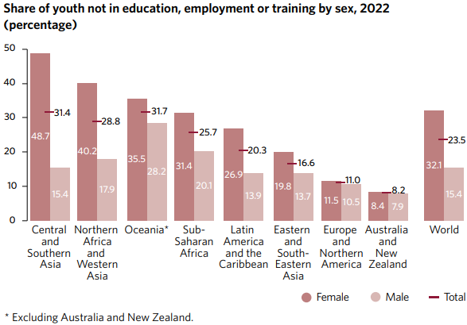
Target 8.6: Globally, nearly one in four (23.5%) young people were not in education, employment, or training (NEET) in 2022. Although this is a slight decrease since 2020, when the NEET rate was at an all-time high, it remained above the 2015 baseline of 22.2% and a long way from the 2030 target. In 2023, the global NEET (not in education, employment, or training) rate for young people was 21.7%, showing a significant decrease since 2020 and nearing the 2015 baseline of 21.8%. This rate is expected to persist through 2025. There is a critical need to intensify initiatives aimed at reducing NEET rates among youth, especially focusing on young women. Globally, young women are still more than twice as likely as young men to be NEET.
Target 8.7: The latest estimates indicate that the number of children in child labor rose to 160 million worldwide at the beginning of 2020 – an increase of 8.4 million children in the last four years. This was translated to almost 1 in 10 of all children in child labor worldwide.
Target 8.8: Globally, many workers face significant risks in their workplace, and work accidents remain prevalent. In 11 out of 93 countries with data, more than 10 work-related fatalities per 100,000 workers were reported. Additionally, in half of the 96 countries with available data, the number of non-fatal injuries per 100,000 workers exceeded 641.
Target 8.9: The share of tourism in global GDP nearly halved in 2020 because of the COVID-19. The 2021 there was a modest 6% upturn, indicating that tourism’s economic contribution is on the path to recovery. In 2022, it rebounded to 82% of its 2019 level, contributing 3.1% to global GDP. This rebound was driven by pent-up demand and loosened travel restrictions, although regional disparities remained. With tourism economic performance at 68% and 43% of pre-pandemic levels, respectively, Oceania—apart from Australia—as well as New Zealand and SIDS continued to confront difficulties.
Target 8.10: Accelerated adoption of digital solutions was transforming access to finance. 76% of adults worldwide had an account at a bank or other regulated organization, such as a credit union, microfinance company, or mobile money service provider, in 2021, up from 62% in 2014. Global access to finance has expanded since 2015, although access methods have changed in recent years. While commercial bank branches decreased from 15.0 to 13.7 per 100,000 adults, the number of ATMs per 100,000 adults decreased from 64.6 in 2015 to 63.9 in 2022.
The COVID-19 pandemic has accelerated the shift towards digital financial access. This reflects a global decline in bank branches, except in Central Asia, Southern Asia, and sub-Saharan Africa.
Target 8.a: The Global Findex 2021 reports that despite 76% of adults having a financial account, 41% lack financial resilience. Financial resilience means being unable to access extra funds equivalent to 5% of their country’s gross national income within 30 days of a financial shock like a health emergency or job loss. This varies by region, with South Asia being the least financially resilient (only 32%) and East Asia the most (77%).
Target 8.b: In 2023, less than half of the reporting countries (36 out of 87) implemented a national strategy for youth employment. About one-third of these countries possess a strategy but lack clear evidence of its implementation, while 1/5 are in the process of developing one.
Important points of the current stage (The Sustainable Development Goals Report 2024)
- Multiple crises are placing the global economy under serious threat. It is anticipated that real GDP per capita would continue to decline globally. As economies start to recover, the global unemployment rate has experienced a significant decline. However, the youth unemployment rate continues to be much higher than the rate for adults, indicating ongoing challenges in securing employment opportunities for young people.
- Tourism is on a path to recovery, but still well below pre-pandemic levels.
- The pandemic has accelerated digital adoption and transformed access to finance.
Let’s consider in more detail:
Global real GDP per capita increased at an average annual rate of 1.8% from 2015 to 2019, then sharply declined by 4.1% in 2020 due to the COVID-19. Then it rebounded in 2021 with a solid 5.2% increase, only to decelerate to 2.2% in 2022. Growth had further dwindled to 1.4% in 2023, followed by a modest increase of 1.6% in 2024.
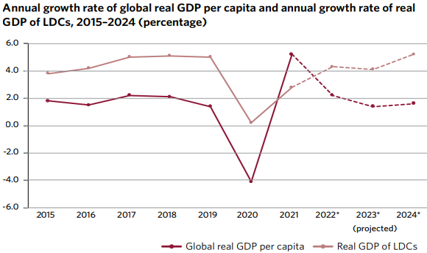
Source: UN, Department of Economic and Social Affairs, Statistics Division, 2023, (— SDG Indicators)
In LDCs, the annual growth rate of real GDP dropped from 5% in 2019 to just 0.2% in 2020 before recovering to 2.8% in 2021. It was estimated that growth would resume, with the annual rate rising to 4.3% in 2022, 4.1% in 2023 and further increasing by 5.2% in 2024. However, these growth rates still fall short of the SDG target of 7%.
Global unemployment is expected to decline. Challenging economic conditions are pushing more workers into informal employment. The global unemployment rate declined significantly in 2022, falling to 5.4% from a peak of 6.6% in 2020 as economies began recovering from the shock of the COVID-19 pandemic. The rate declined further in 2023, to 5.3% (191 million people), which reflected stronger-than-expected labor market resilience in high-income countries, but in low-income countries.
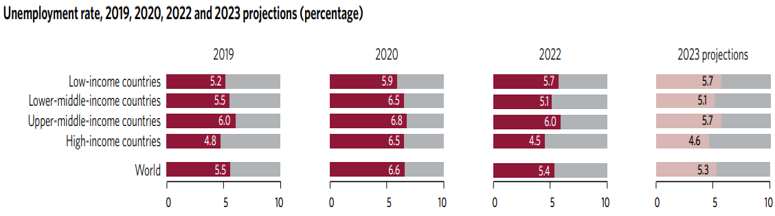
Source: UN, Department of Economic and Social Affairs, Statistics Division, 2023, (— SDG Indicators)
Women and young people were disproportionately impacted by the epidemic in the labor economy. Compared to men, women saw a more robust recovery in employment and labor force participation. The global youth unemployment rate is significantly greater than the rate for adults aged 25 and over, and young people between the ages of 15 and 24 still struggle greatly to find good jobs.
The prevalence of informal work had been gradually decreasing before to the pandemic, falling from 58.6% in 2015 to 57.8% in 2019. Informal workers, especially women, lost disproportionately many jobs as a result of COVID-19 lockdowns and containment. Informal employment, or work without social protection, drove the recovery that followed. In 2022, it increased slightly to 58.0%.
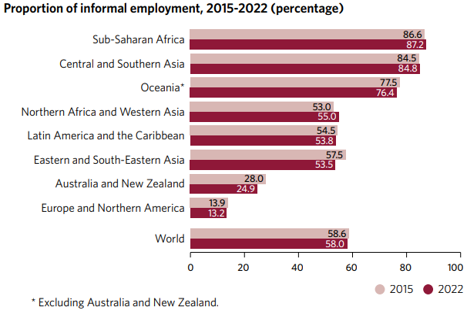
Source: UN, Department of Economic and Social Affairs, Statistics Division, 2023, (— SDG Indicators)
In LDCs, where informal employment remained at 89.7% in 2022 and had not decreased since 2015, the situation was particularly concerning. With four out of five jobs established in recent years for women being informal, compared to just two out of three occupations for men, women have fared worse throughout the employment recovery.
Globally, nearly 1 in 4 young people (23.5% or 289 million) were not in education, employment or training (NEET) in 2022. While this is a slight decrease from the peak in 2020, it remains higher than pre-pandemic levels of 22.2%.
Source: UN, Department of Economic and Social Affairs, Statistics Division, 2023, (— SDG Indicators)
Across regions, the situation remains most dire for young people in Central and Southern Asia and in Northern Africa and Western Asia, with NEET rates of 31.4% and 28.8%, for 2024. Meanwhile, sub-Saharan Africa recorded the highest rate increase, with now more than 25% of young people in NEET. Young women remained more than twice as likely (32.1%) as young men to NEET.
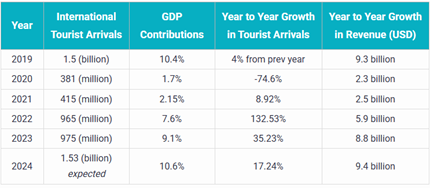
Tourism has been severely impacted by the COVID-19 pandemic. By 2020, tourism’s contribution to the world economy had almost halved. A slight improvement of 6% occurred in 2021 (a 2.5% increase in the world GDP), and it is still happening today. Even while this suggests that tourism is rebounding, it is still far lower than the 4.2% pre-pandemic level in 2019.
In 2021, tourism had higher economic contributions in Latin America and the Caribbean (5.9%), Northern Africa and Western Asia (5.2%), Europe and Northern America (2.2%), compared to sub-Saharan Africa (1.2%) and Central and Southern Asia (0.4%).
The tourism industry has shown remarkable resilience post-pandemic, with global travel on an upward trajectory. By 2023, international tourist arrivals reached 89% of pre-pandemic levels, accelerating to 98% by September 2024. This resurgence highlights a significant recovery in travel demand across the globe.
The GDP contribution of the worldwide tourism industry has also increased significantly since the COVID-19 epidemic. The industry is projected to generate $11.1 trillion in 2024, which is 10% of the world GDP and a 12.1% growth from the previous year. A strong return to pre-pandemic economic levels and beyond is shown by this growth pattern.
The World Travel & Tourism Council (WTTC)3 predicts that travel and tourism will account for $1 in every $10 spent globally in 2024.
Overall tourism market 2024
Source: Global tourism statistics, 2024, https://wptravel.io/global-tourism-industry-statistics/#h-global-tourism-statistics-2024
As predicted by Statista in 2022, the tourism sector has successfully rebounded, with tourists increasingly engaging in both inbound and outbound travel.
COVID-19 has accelerated digital adoption and transformed access to finance. Although the pandemic has claimed countless lives, devastated the world economy, etc., this challenge has given rise to several innovations that have had a positive impact on some services. This has also occurred in the financial industry, where an unparalleled number of internet services have emerged, making them more accessible to everybody.
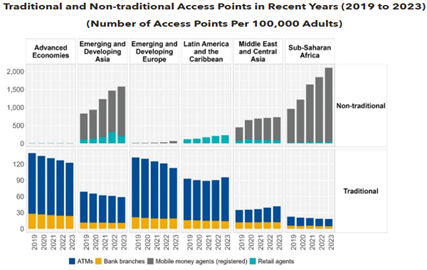
Digital Financial Services Continue to Make Gains. A characteristic trend of Pandemic period was the increasing intensity of use of non-traditional financial services (mobile and internet banking). The usage of traditional financial services still remains essential. For example, from 2013 to 2019, deposit accounts per 100 adults increased by over 40% in emerging and developing Europe and Sub-Saharan Africa. The growth of digital financial services has also led to an increase in non-traditional access points (retail and mobile money agents), while traditional access methods like ATMs and bank branches have seen a decline, especially since the COVID-19 pandemic.
Source: Financial Access Survey and IMF staff calculations,
These charts show the weighted average by region for economies whose data are available for 2019–2023. Country coverage differs across indicators depending on data availability. While three economies from Latin America and the Caribbean (El Salvador, Colombia, and Haiti) report data on number of registered mobile money agents, none provide data for all five years covered in this chart and are therefore not included.
There are still significant gender disparities in the use of financial services, despite the advantages of include women in the financial system. The use of loan and deposit accounts is where these disparities are most noticeable. Globally, women’s outstanding loan balances make up only 46% of men’s, although their outstanding deposit amounts represent 64% of men’s. Comparing industrialized economies to emerging economies, the former exhibit greater gender equality in financial inclusion. Of the latter, Latin America and the Caribbean, as well as emerging and developing Europe, exhibit comparatively greater gender equality.
A few key highlights:
- Globally, 76% of adults had bank accounts or accounts with regulated institutions in 2021, up from 62% in 2014.
- The accelerated adoption of digital solutions, driven in part by the COVID-19 pandemic, is transforming access to finance.
- Technology has played a crucial role in advancing financial inclusion,
- New opportunities to reach the unbanked services include leveraging digital payments, along with interoperable payments networks and telecommunications infrastructure.
- During the COVID-19, 39% of adults in low- and middle-income economies opened their first account at a financial institution.
New opportunities to reach the unbanked services include leveraging digital payments, such as direct transfers of social welfare or wage payments, along with interoperable payments networks and telecommunications infrastructure.
3 WTTC – https://wttc.org/
Brief summary of challenges of recent period
To briefly summarize the chapter, let’s focus on several key aspects, including:
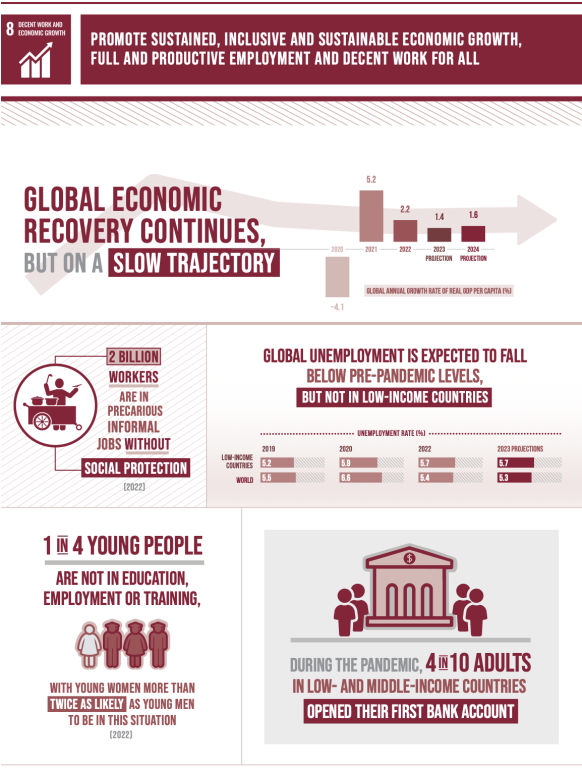
- Global economic recovery continues, but on a slow trajectory. The global economy is grappling with persistent inflation, increasing interest rates and heightened uncertainties.
- Inclusive and sustainable economic growth can drive progress and generate the means to implement the Sustainable Development Goals.
- States should implement a consistent policy towards labor formalization that considers the needs of workers and allows any of them to benefit from the social protection available in the country.
- Global unemployment is expected to fall below pre-pandemic levels, but not in law-income countries.
- Equal treatment in employment, including fair and equitable earnings, is fundamental for achieving decent work for all.
- Challenging economic conditions are still pushing more workers into informal employment. More than 2 billion workers are in precarious informal jobs without social protection.
- 1 in 4 young people are not in education, employment or training, with young women more than twice as likely as young men to be in this situation. Efforts to reduce youth NEET rates, especially among young women, need to be intensified to address the long-term impacts on their economic potential and future opportunities.
Source: https://sdgs.un.org/goals/goal8
- Challenges in Narrowing Gender Gaps Remain.
- The introduction of new technologies has diversified financial services and increased their accessibility to everyone. During the pandemic, 4 in 10 adults in low and middle-income countries opened their first bank account.
- Achieving Goal 8 will require a wholesale reform of the financial system to tackle rising debts, economic uncertainty and trade tensions, while promoting equitable pay and decent work for young people.
Ultimately, it can be said that the full implementation of the Sustainable Development Goals faces great challenges. Therefore, achieving the goals depends significantly on deepening the links between the goals and combining efforts to solve the problems.
A clear roadmap for accelerated synergistic actions is needed to align efforts and bring the 2030 goals closer to reality. To facilitate integrated action, the strategy needs to map out areas with high-impact synergy and propose actionable steps to strengthen synergies at all levels.
Literature
International Institute for Sustainable Development IIISD), n.d., Sustainable Development, viewed 15.04.2025, <https://www.iisd.org/mission-and-goals/sustainable-development>.
United Nations, 2016. Report of the Secretary-General, Progress towards the Sustainable Development Goals 2016, viewed 25.03.2025, <https://digitallibrary.un.org/record/833184?v=pdf>.
United Nations, 2017. Report of the Secretary-General, Progress towards the Sustainable Development Goals 2017, viewed 05.04.2025, <https://digitallibrary.un.org/record/1288024/?ln=ru&v=pdf>.
United Nations, 2018. Progress towards the Sustainable Development Goals: report of the Secretary General, viewed 20.04.2025, <https://digitallibrary.un.org/record/1627573?v=pdf>.
United Nations, 2018. Report of the Secretary-General, Progress towards the Sustainable Development Goals 2018, viewed 05.04.2025, <https://digitallibrary.un.org/record/1627573?v=pdf>.
United Nations, 2019. Report of the Secretary-General, Progress towards the Sustainable Development Goals 2019, viewed 10.04.2025, <https://digitallibrary.un.org/record/3810131?v=pdf>.
United Nations, 2020. Report of the Secretary-General, Progress towards the Sustainable Development Goals 2020, viewed 10.04.2025, <https://digitallibrary.un.org/record/3865828?v=pdf>.
United Nations, 2021. Report of the Secretary-General, Progress towards the Sustainable Development Goals 2021, viewed 11.04.2025, <https://digitallibrary.un.org/record/3930067?v=pdf>.
United Nations, 2022. Report of the Secretary-General, Progress towards the Sustainable Development Goals 2022, viewed 11.04.2025, <https://digitallibrary.un.org/record/3977147?v=pdf>.
United Nations, 2023. The Sustainable Development Goals Report 2023, viewed 20.04.2025, <https://sdgs.un.org/documents/sustainable-development-goals-report-2023-53220>.
United Nations, 2024. The Sustainable Development Goals Report 2024, viewed 22.04.2025, <https://files.unsdsn.org/sustainable-development-report-2024.pdf>.
United Nations, n.d., SDG 8. Promote sustained, inclusive and sustainable economic growth and productive employment and decent work for all, viewed 15.04.20205, <https://sdgs.un.org/goals/goal8>.
United Nations, Report of the World Commission on Environment and Development: Our Common Future, viewed 04.04.2025, <https://sustainabledevelopment.un.org/content/documents/5987our-common-future.pdf>.
World Travel & Tourism Council, 2024. Global Tourism Statistics, 2024 Trends and forecasts, viewed 15.04.2025, <https://wptravel.io/global-tourism-industry-statistics/#h-global-tourism-statistics-2024>.
Videos
SDG 8: decent work and economic growth. Introduction.
SDG 8: decent work and economic growth. CSR in theory
Mariam Labuchidze
SDG 8: decent work and economic growth. CSR in practice
Mariam Labuchidze
Take a quiz
Test your knowledge on this topic.
Take this short quiz and see if you can score 100%.