
Case Study
SDG 16, peace, justice and strong institutions: Barriers to Justice for Vulnerable Groups

Although Georgia is not part of the European Union and has not historically been a mass refugee destination, several factors make it particularly appealing to refugees from the Middle East. Georgia is positioned between Europe and Asia and serves as a corridor for refugees moving westward from conflict zones such as Syria, Iraq, and Afghanistan. It is often viewed as a relatively safe stopover or settlement option. Citizens of several Asian countries can enter Georgia without a visa. Georgia’s immigration policies are relatively open, and the country allows individuals to apply for asylum under national legislation. Despite being a predominantly Christian country, Georgia has a long history of religious coexistence. This creates a more inclusive environment for Muslim refugees, many of whom come from Syria or Iraq. Existing Muslim communities in regions like Adjara and Kvemo Kartli ease cultural adaptation.
Georgia is a signatory to the 1951 Refugee Convention and maintains its own national asylum procedures. Individuals can apply for asylum and, in theory, receive legal status and access to basic social services. Compared to many countries in the region, Georgia has a lower cost of living – particularly in rural areas – which appeals to displaced families. In addition, a number of NGOs (such as UNHCR, Rights Georgia, and the Georgian Young Lawyers’ Association) provide essential legal and social support. This broader context helps explain why Ali – the minor described in the case study – came to Georgia and sought legal protection there, despite the numerous systemic and procedural barriers he encountered.
Ali, a 17-year-old minor from Syria seeking asylum
Ali arrived in Georgia at the age of 14 after losing his parents to war. Upon arrival, he lived in an informal shelter with other displaced persons. He had no documents, did not speak Georgian, and had no legal representative. At 16, Ali attempted to apply for asylum. However, the request was denied due to the lack of documentation, unresolved identity status, and a claimed need for a full medical evaluation. He was not provided with an interpreter or legal representative and did not understand the asylum process or his rights. One of the local NGOs accidentally learned about his situation and referred him to the Legal Aid Service. With the support of public defenders, his case was reopened, psychosocial support was provided, and ultimately, the court recognised Ali’s right to asylum under Georgian law.
This case illustrates both the transformative potential of coordinated action between the state and civil society, and the systemic barriers faced by vulnerable individuals:
- Language and cultural obstacles;
- Lack of access to legal information;
- Institutional and geographic limitations;
- Neglect of the special status and needs of minors.
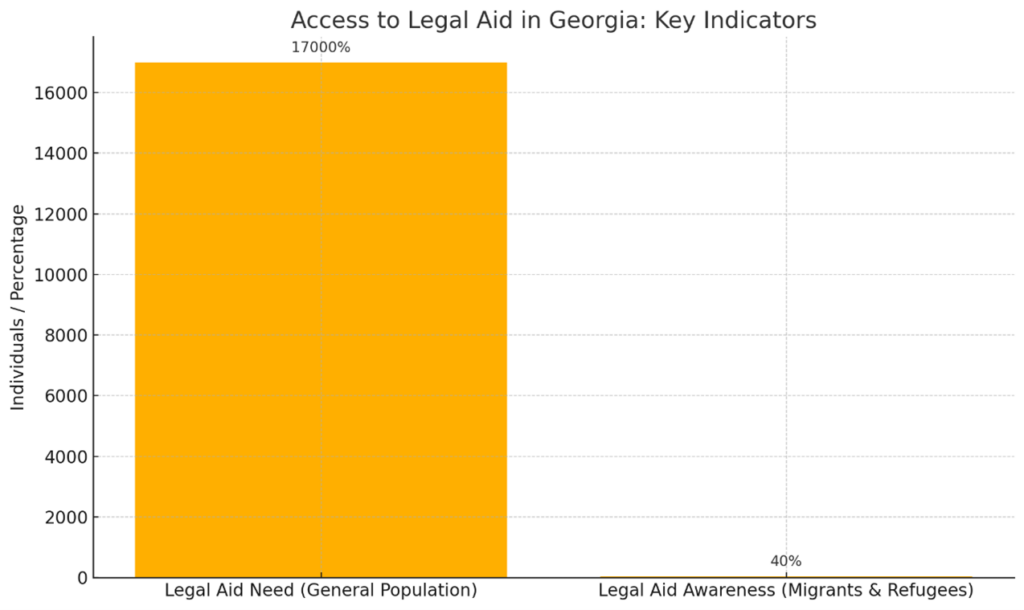
Within Georgia’s legal aid framework, over 17,000 individuals require legal assistance annually, highlighting a significant demand for accessible justice services, especially among vulnerable populations.
The situation is even more critical for migrants and refugees – as of 2023, less than 40% are aware of their right to free legal aid. This low level of awareness severely limits their ability to seek timely legal remedies, challenge administrative decisions, or defend their rights effectively.
In response to this gap, state institutions and civil society organisations have launched joint mobile legal clinic initiatives, reaching remote regions and underserved communities. These initiatives are particularly crucial in cases like that of the minor asylum seeker described in the case study, ensuring legal support reaches individuals who otherwise might remain excluded from the justice system.
Questions
- What were the main legal and social barriers Ali faced in accessing justice?
- How does this case reflect the essence of SDG 16.3 – promoting the rule of law and equal access to justice?
- In what ways did language and Ali’s status as a minor affect his case?
- What role did the NGO sector play in this legal process?
- How can collaboration between state institutions and civil society be strengthened to support vulnerable individuals?
- What preventative strategies can ensure early and equitable access to justice for others like Ali?
List of references
Gobronidze Mariam, Tornike Gerliani, Ana Papuashvili, 2021, Access to Justice in Georgia, viewed 16 March 2025, <https://socialjustice.org.ge/uploads/products/pdf/Access_to_Justice_in_Georgia_1632406837.pdf>.
Mosulishvili Medea, 2018, Legal aid improves access to justice in Georgia, viewed 17 March 2025, <https://www.undp.org/georgia/stories/legal-aid-improves-access-justice-georgia>.
Report on the legal status of asylum seekers and persons with international protection in Georgia, Special report, viewed 11 March 2025, <https://www.ombudsman.ge/res/docs/2022112910515591918.pdf>.
Strengthening Civil Justice with SDG 16.3.3, 2025, viewed 15 March 2025, <https://sdg.iisd.org/commentary/guest-articles/from-data-to-action-strengthening-civil-justice-with-sdg-1633>.